Home FeaturedThe fine art of not being a jerk: Why cynicism isn’t leadership

The fine art of not being a jerk: Why cynicism isn’t leadership

by Todd Humber
A+A-
Reset

I was taught to question everything.

As a young reporter, that instinct served me well. Press releases became puzzles to decode. Corporate spin was background music to ignore. Every grand announcement deserved a raised eyebrow and a follow-up call. Cynicism wasn’t a character flaw — it was professional armour.

Now that I’ve got more than few grey hairs poking out, I’ve learned something else. That armour, while useful, can also be a cage.

The same skepticism that made me good at spotting BS came with a side effect: A propensity to dismiss ideas before they had oxygen. The reflex to poke holes became automatic. And in a world that seems designed to reward the clever put-down over the generous response, that reflex spread beyond the newsroom and into how I approached just about everything.

I’m not alone in this. We’re living through what feels like the Olympic Games of cynicism. Political discourse is a blood sport. Social media rewards the snarkiest takedown. Cable news panels treat optimism like a character defect.

Even our workplace culture has absorbed this — where being the person who says “that’ll never work” somehow sounds smarter than the person who says “let’s try it.”

And look, I get it. 2025 didn’t exactly hand us reasons to break out the party hats. Wars ground on. Political divisions deepened. The news cycle felt like an endurance test in maintaining faith in humanity. When the world serves up a steady diet of disappointment, cynicism feels like the rational response.

But cynicism isn’t rationality. It’s a shortcut. It’s intellectual laziness dressed up as wisdom.

The truly difficult work

The truly difficult work isn’t tearing things down. Any fool can do that. The hard part is building something when you know — really know — how easily it can fail. I’ve spent the past few years building North Wall Media from scratch. That included the launch of HR Law Canada, HR News Canada, Safety News Canada, and the HR Talks event series. Every single one of those could have gone sideways. The media landscape is littered with failed publications and cancelled events.

The rational, cynical voice in my head had plenty to say about those odds. But the hard part wasn’t acknowledging the risk. It was showing up anyway, bringing enthusiasm to the work, believing the idea had merit even when carrying the weight of everything that could go wrong.

And yet, that’s exactly what leadership requires.

Top managers have a common trait

The best managers I know share a quality that has nothing to do with their technical skills or strategic vision. They have an almost stubborn resistance to cynicism. Not naivety. They’re not wandering around with their heads in the clouds. They know the odds. They’ve seen the failures. But they choose, actively and deliberately, to create space for possibility anyway.

They’re the ones who hear a half-baked idea in a staff meeting and don’t immediately catalogue its flaws. Instead, they ask questions that help shape it. They know most initiatives will fail, but they also know the ones that succeed almost always start as fragile things that need protection in their early stages.

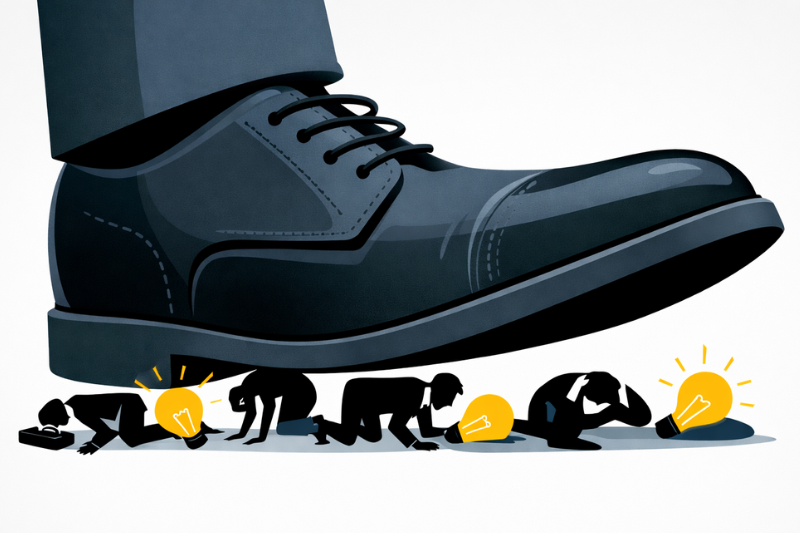
They understand something fundamental: people don’t bring their best selves to work when they’re waiting for someone to tear them down.

Not snuffing out the next generation

I think about this particularly when it comes to younger workers entering the workforce. They show up with ideas and energy, and we have a choice. We can be the voice that says “we tried that in 2009 and it didn’t work” — technically true, unhelpful, conversation-ending.

Or we can be the voice that says, “Interesting. What would make it work this time?”

Same facts, completely different outcome.

The cynicism trap is especially dangerous because it feels like protection. If you don’t get excited about anything, you can’t be disappointed. If you don’t support ideas, you can’t be blamed when they fail. If you maintain emotional distance from your team’s efforts, you won’t feel the sting when things go sideways.

But you also won’t feel much of anything else.

Emotional temperature of leaders

And here’s the thing about workplaces: they take on the emotional temperature of their leaders. If the people in charge approach every suggestion with a world-weary sigh, that becomes the culture. If cynicism is the default setting, innovation doesn’t just slow down. It stops showing up entirely.

None of this means checking your critical thinking at the door. Blind optimism is just cynicism’s equally useless cousin. What I’m talking about is something different: choosing to lead with curiosity instead of skepticism. Asking “what if this works?” before asking “why won’t this work?” Creating environments where failure isn’t fatal and trying something new doesn’t require running a gauntlet of eye rolls.

The world gives us plenty of reasons to be cynical. I’m not arguing otherwise. But the whole point of leadership — arguably the only point — is to create pockets of possibility despite that. To build teams where people feel safe bringing forward ideas that might be terrible. To support initiatives that might fail. To show up with energy and hope even when the news cycle suggests that’s a sucker’s bet.

The stories we tell ourselves about the world have a funny way of becoming true. If we decide everything is broken and nothing will work and people are fundamentally disappointing, we’ll find endless evidence to support that view. And if we decide there’s potential worth nurturing and ideas worth developing and teams worth believing in, we’ll find evidence for that, too.

Related Posts

Leave a Comment