


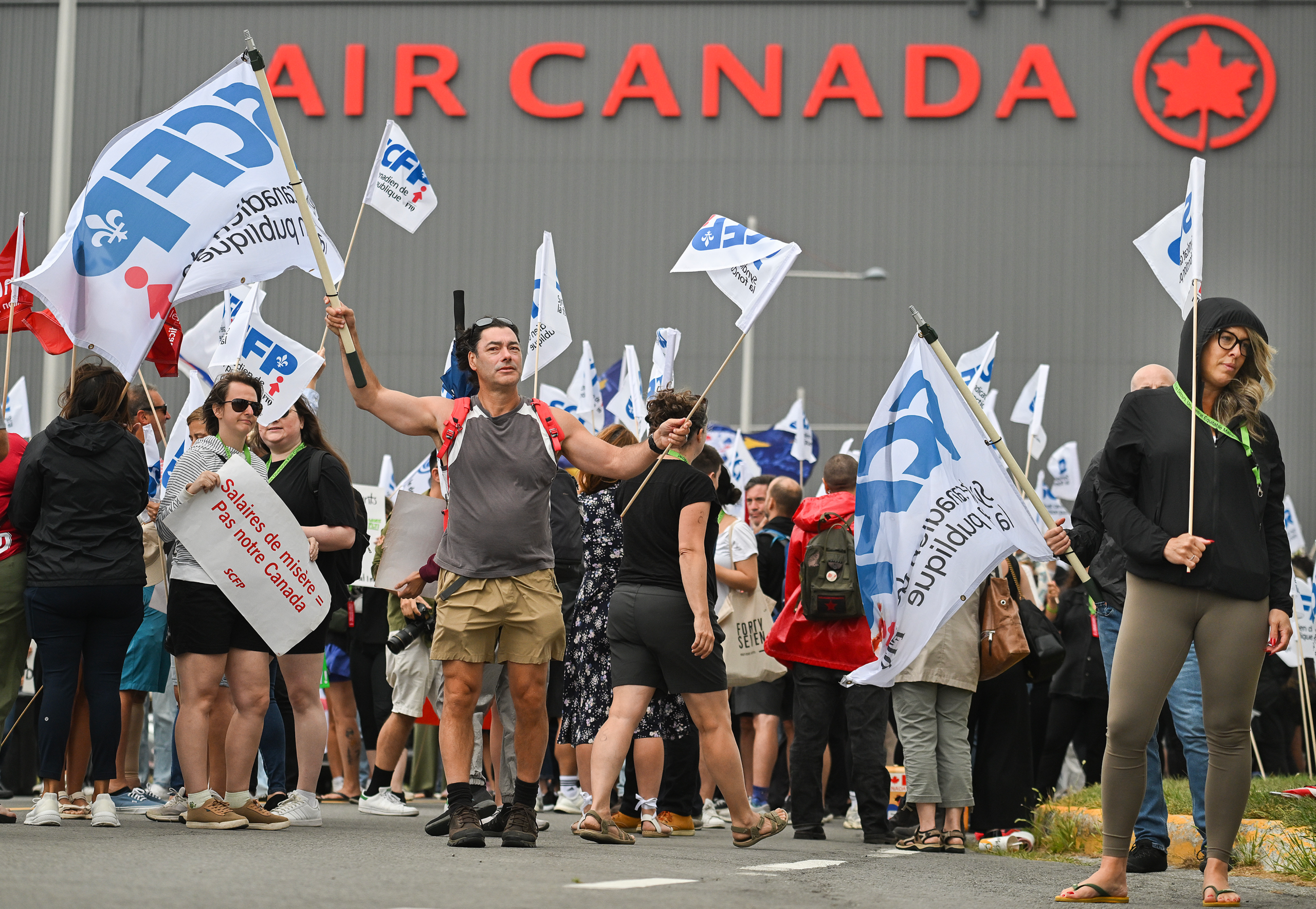
An arbitrator reviewing wages for flight attendants at Air Canada has finalized rates at the airline, bringing an end to the labour dispute that saw travel disrupted for thousands of people last summer.
The arbitrator maintained the rates agreed to in a tentative deal for flight attendants at Air Canada’s mainline, but bumped up the increase in the first year for those at Rouge.
The bargaining committee for the Air Canada component of the Canadian Union of Public Employees said it was not the outcome the union fought to achieve.
More than 10,000 Air Canada flight attendants went on strike last August, upending thousands of customers’ travel plans.
Ottawa intervened in the strike less than 12 hours after it began, invoking Section 107 of the Canada Labour Code to force the airline and the union into binding arbitration. The Canada Industrial Relations Board ordered flight attendants to return to work a day later.
That order was defied by union officials, leading the board to state that the strike was unlawful even as the union said it would press ahead.
The company and union resumed negotiations a few days later before reaching a tentative agreement.
A large chunk of the terms within the tentative deal — such as those setting out rules for pensions and retirement bridging, health benefits, prone rest and vacation — were already considered final, as agreed to by both Air Canada and the union.
However, Air Canada’s flight attendants voted over 99 per cent to reject the wage offer in the agreement in September.
The union and the airline agreed at the time that if members rejected the deal, the wage portion would be referred first to mediation and then, if no settlement was reached, to arbitration.
The contract includes a 12 per cent salary increase this year for most junior Air Canada flight attendants and an eight per cent bump for more senior members in the first year of the contract.
Rouge flight attendants will receive a 13 per cent increase in the first year of the deal, an increase of one percentage point from the initial tentative agreement.
The contract includes an increase of three per cent in the second year, 2.5 per cent in the third year and 2.75 per cent in the fourth for both Air Canada and Rouge flight attendants.
The agreement, which runs until March 2029, also addressed the contentious issue of unpaid work while aircraft are not in the air.
Flight attendants now receive half their hourly wage rate for 60 minutes of ground time on narrow-body aircraft and 70 minutes on wide-body planes. That is to rise to 60 per cent of the hourly wage rate in April, 65 per cent in 2027 and 70 per cent in 2028.
Those terms surrounding ground pay were considered final at the time of the deal and not subject to the arbitration process.
Earlier this month, the federal government published the initial findings of a probe it launched last year into allegations made by Air Canada’s flight attendants that they were not being paid for ground duties.
Employers in federally regulated industries like the airline sector must compensate employees at or above a bar set by the federal minimum wage.
Jobs Minister Patty Hajdu’s department said the first phase of its probe did not find evidence that compensation practices in the airline sector fall short of the federal minimum wage set out in the Labour Code.
But its report did flag that compensation practices for many part-time and entry-level flight attendants warranted “closer examination.”


