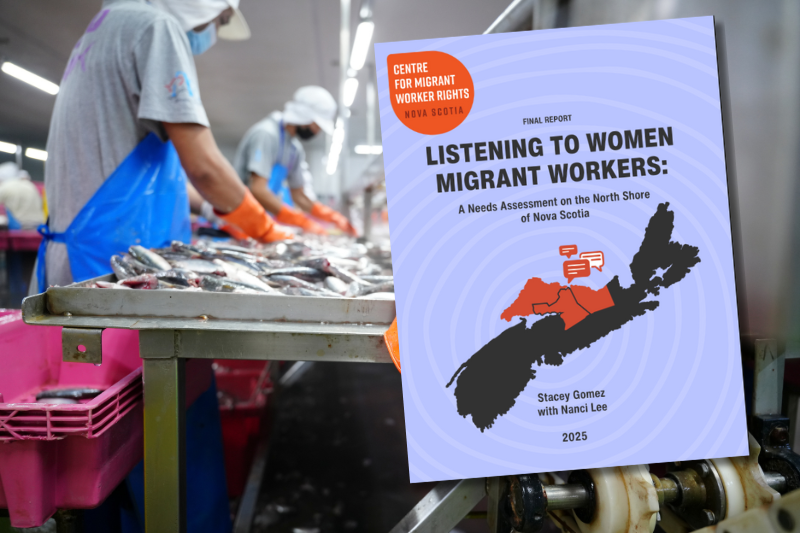
Women migrant workers in Nova Scotia’s agriculture and seafood processing industries face poor housing conditions, barriers to healthcare access, exploitative working conditions and a lack of social supports, according to a new report examining the Temporary Foreign Worker Program.
The Centre for Migrant Worker Rights Nova Scotia released findings from a needs assessment conducted between June and August 2025 that surveyed 29 women migrant workers, held listening circles with 15 participants and interviewed four workers employed on farms and in seafood plants in the province’s North Shore region.
The report found that employers exercised control over nearly every aspect of workers’ lives, including housing, private health insurance, ability to work in Canada, immigration status and even their time. The assessment focused on women migrant workers from Jamaica, St. Lucia and Mexico working in Colchester, Cumberland and Pictou counties.
Housing conditions and workplace challenges
Survey respondents identified overcrowding and lack of privacy at home as a top concern, with 62 percent citing too few appliances, washrooms or other facilities. Women reported living in houses with more than 20 people equipped with only two washing machines, two bathrooms and one stove.
Workplace conditions presented significant challenges. Among farm workers, 70 percent identified working in bad weather conditions as their primary concern, while 57 percent reported harsh or inappropriate behaviour from supervisors. Women described working long hours on their knees in extreme heat, rain or cold, with one worker stating that penalties were imposed if they chose not to work in the rain.
Seafood processing workers reported different but equally severe issues. The majority cited lack of sufficient work hours and unpredictable scheduling as major problems. Workers described being constantly on standby for work with little advance notice, making it impossible to plan rest or social activities.
Healthcare access and employer control
The report documented significant barriers to healthcare access. In Nova Scotia, migrant workers must have a one-year work permit to qualify for the provincial Medical Services Insurance program. Workers with permits of less than one year, including all Seasonal Agricultural Worker Program participants, must rely on private health insurance tied to their employment.
Women reported that employers acted as gatekeepers for healthcare services, accessing their confidential health information, influencing prescribed medications and postponing or refusing to take them to seek medical attention. Some described having to choose between seeking medical care and sending money home to their families due to financial constraints.
One worker whose permit was one month short of the 12-month requirement for provincial coverage stated the insurance provided by her employer covered only $500 in medical expenses. Workers also reported high costs for hospital visits that they were required to pay before leaving the facility.
Financial vulnerability and gender-specific challenges
Workers reported paying between $3,400 and $3,800 in fees to come to work in Canada, including medical testing, biometric and visa fees. This financial burden, combined with low wages and illness, deepened their vulnerability and dependence on maintaining their employment.
The report identified gender-specific challenges including sexual harassment in the workplace and gender inequality in labour market access. Two women shared examples of sexual harassment, stating that declining to provide phone numbers to male coworkers or acquiescing to sexual advances could result in not being rehired or not receiving help at work.
In the seafood processing sector, women reported that when fewer hours were available, men were offered additional tasks such as gardening, maintenance, carpentry and driving, while women were not given equal access to these opportunities. Workers noted that employers cannot require migrant workers to perform work outside their employment contract, as this jeopardizes their worker status in Canada.
Emotional strain and family separation
Participants emphasized that separation from children and families created significant emotional and financial burden, particularly for women in caregiving roles. Those who identified as single mothers experienced heightened pressure as sole providers for their children.
The majority of women reported little or no social supports available to them in Nova Scotia. Language barriers presented an additional challenge for Spanish-speaking workers from Mexico.
Policy recommendations
The report includes recommendations for federal and provincial governments. At the federal level, recommendations include providing migrant workers with permanent residence status on arrival, open permits instead of employer-specific permits, enabling workers to be accompanied by families, adopting enforceable national housing standards with maximum occupancy of one worker per room, requiring union representation and renewing funding for the Migrant Worker Support program.
Provincial recommendations for Nova Scotia include increasing the minimum wage to a living wage and providing provincial health care coverage on arrival to all migrant workers.
The report also recommends that the provincial government conduct regular unannounced workplace inspections, implement arms-length housing inspections, proactively assess workplaces for systemic discrimination including gendered racism, and amend the Labour Code to require employers to provide pay for contracted hours even when no work is available, require advance notice for work schedules, remove agricultural exemptions for overtime and holiday pay, and include paid sick days for all workers.
Program context and worker numbers
According to Immigration, Refugees and Citizenship Canada, 4,145 migrant workers were employed in Nova Scotia in 2023. Of those, 1,964 worked in agricultural industries and 1,814 in food and beverage manufacturing.
Women represent a growing segment of the agricultural migrant worker population. In 2017, 7.6 percent of migrant workers employed in Canada’s agricultural sector were women, compared to 5.2 percent in 2005. Across all sectors in 2019, 18 percent of the 98,000 temporary work permits issued were to female workers.
The Centre for Migrant Worker Rights Nova Scotia conducted the needs assessment with funding from the Canadian Women’s Foundation. The organization provides support services and rights education to migrant workers across the province.