


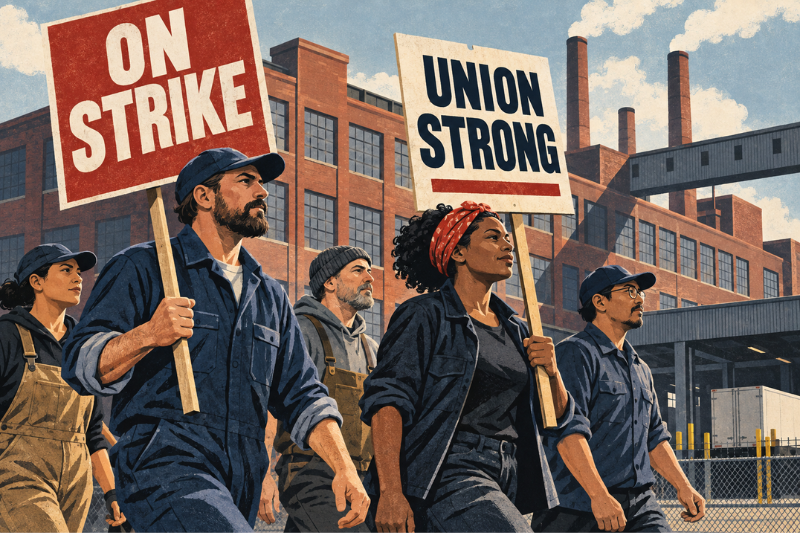
The request was for a stool.
Also a 30-pound lifting restriction, 15 minutes of sitting every four hours, and shifts capped at eight hours. That is what Jennifer Hatch, who processed customer returns at an Amazon facility in Lancaster, N.Y., asked for after her doctor classified her pregnancy as high risk. According to a proposed class action filed this week in Brooklyn federal court, Amazon delayed and then denied the requests. In March 2025, the complaint says, she was struggling to breathe and a manager would not let her use an available chair, because the accommodation had not been approved. She clocked out early more than once to get to hospital for abdominal pain. Amazon docked her unpaid time off and later fired her for violating the attendance policy.
Amazon disputes the account and says it approved more than 99.9 per cent of pregnancy-related accommodation requests over the past year.
I believe the number. It is also beside the point. Nobody organizes over the 99.9 per cent.
Years ago, in an interview I can no longer place, someone told me that “You get the union you deserve.” Treat people decently and they rarely go looking for one. Do the opposite long enough and you end up across a table from someone with a long memory and a longer list.
Which brings me to our side of the border, in British Columbia, where Amazon Canada Fulfillment Services has just failed to pause an order sending it to binding interest arbitration with Unifor. The company had asked the B.C. Labour Relations Board for a stay while it pursued a reconsideration application filed in August, and while a decertification vote sought by a group of employees sat in sealed ballot boxes. Vice-chair Kaity Cooper dismissed the application. The parties have already picked an arbitrator. Hearings could begin in October.
One of Amazon’s three arguments is worth a closer look. Compelled arbitration, it told the board, would breach sections 2(b) and 2(d) of the Charter by removing the option to strike or lock out, a loss of leverage the company called non-compensable and irreversible. Cooper left the merits to the reconsideration panel and found only that the harm was not permanent, since the board could always order a new process later.
Set aside whether the argument is right. Notice what it is: An employer insisting that the economic test of strength is a constitutional entitlement it cannot be denied.
Now read the federal government’s new “What We Heard” report, released after two rounds of consultations on modernizing the Canada Labour Code. Unions and employers turn out to agree on a surprising amount: more resources for mediation and the Canada Industrial Relations Board, tougher enforcement against misclassification and wage theft, a modernized health and safety framework, better training for workers displaced by automation. Where they split, hard, is over section 107, the provision that lets the labour minister direct the CIRB to do what it takes to settle a dispute, up to and including ordering people back to work.
Many employers want that tool kept for rare, economically damaging disputes in ports, rail and telecommunications. Nearly all unions want it repealed or sharply narrowed. One union participant put the objection plainly: frequent use of section 107 discourages employers from bargaining at all, because they know someone will come and bail them out.
The right to a test of strength is precious when it is yours, and a public hazard when it belongs to the other side. That is not hypocrisy so much as ordinary self-interest, and both camps practise it. But it carries a cost. Every dispute that ends by ministerial direction or board order is a dispute the parties did not learn to settle themselves. Both sides told Ottawa that about 95 per cent of federal collective agreements are reached without a work stoppage, and both offered it as proof the system works.
It is also a reminder that the system mostly works when nobody is waiting for a rescue.
Another illustration but, this time, not from a warehouse. Rather, it’s behind the wheel. On Sept. 2, the United Food and Commercial Workers (UFCW) announced that hundreds of Uber drivers across the Okanagan, Kootenay and Cariboo regions had joined the collective agreement first bargained by drivers in Victoria. The terms are not the stuff of barricades: a health spending fund, quarterly bonuses, annual increases to waiting, cancellation and out-of-region fees, a formal dispute process, and union representatives who appear in person. A Kelowna driver said what representation gave him was the ability not to face account problems alone.
Somewhere, in a product meeting in the halls of Uber, someone decided that driver support would be a form rather than a person. The reply arrived as a certification.
None of this is an argument that unions are good, or bad, or inevitable. It is a narrower claim. Organizing is slow, expensive and socially awkward. People do not undertake it when the ordinary channels work. They undertake it when a supervisor says no to a chair that is standing right there, or when the only way to reach a decision-maker is to hire one.
The union you deserve does not arrive as a picket line. It arrives as a stranger with the authority to decide things you used to decide, because you gave someone on your payroll a reason to hand over the pen.