

The cap on a European water bottle stays attached after you twist it open. It swings from a little plastic collar and bumps your nose while you drink. That is mildly irritating for about a day, and then it starts to seem admirable. After all, it keeps the cap off the beach and out of the ocean.
I want to be European. The bottle caps aren’t really part of the reason… but the food might be. Everything just tastes better on that side of the ocean for reasons I am not qualified to explain.
Mostly, though, my reason is one a lot of Canadians have been giving lately: I am tired of depending on the United States. How much you share that feeling will depend on where you sit politically, but the things I envy about Europe are hardly exotic. Universal health care, sensible gun laws, programs and policies to help neighbours in tough times, and regulation that assumes someone ought to be thinking about the public.
On most of that list, Ottawa already looks more like Brussels than Washington.
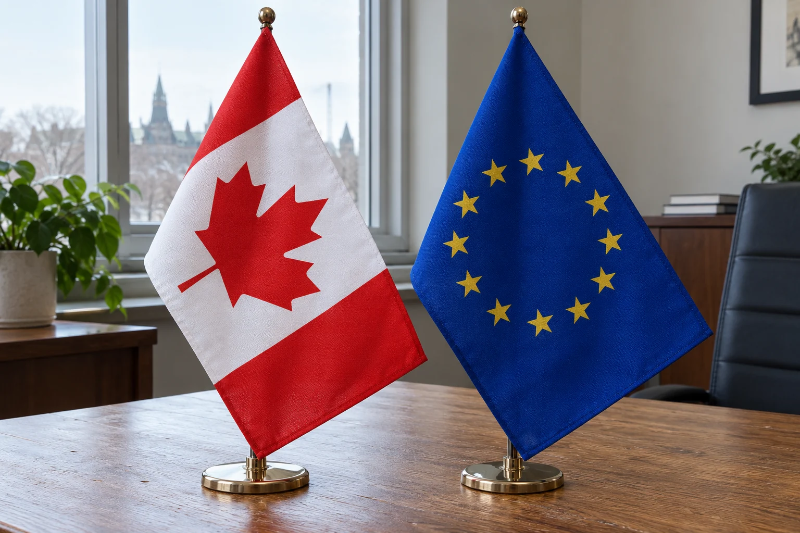
So I paid attention this morning when Prime Minister Mark Carney stood in Montreal between European Commission President Ursula von der Leyen and European Council President António Costa and said Canada is working to become the European Union’s first associate member.
“We are working toward the deepest possible partnership, short of accession because of our geography,” he said.
Geography is the one clause no negotiator can strike out. Nearly everything else is still open, including what associate membership would actually mean. The status does not exist yet. A Canadian official briefing reporters afterward could not say what legislation it would require in Canada or in the member states. “It’s a concept,” the official said. Carney hopes to conclude negotiations in June 2027.
Not everyone in Europe has signed on. Sources said the words “associate member” were cut from the draft joint statement after some members objected, and one said Germany called the term a red line. The final text settled for “an ever-closer association of Canada to the EU, short of full membership itself.”
Progress already happening
The summit did produce a digital trade agreement meant to ease cross-border data flows. It also produced a commitment to widen opportunities for Canadians and Europeans to study, work and do research in each other’s territory. Anyone who hires should read those two items carefully, and then read past them. The things I admire about Europe as a citizen arrive on an employer’s desk as compliance obligations. The gap between the two systems is wider than a shared fondness for public health care suggests.
Start with pay. Member states were required to bring the EU’s pay transparency directive into national law by June 2026. It bars employers from asking candidates about their salary history, requires them to disclose starting pay or a range before the interview, and obliges larger employers to report their gender pay gaps. An unexplained gap of five per cent or more triggers a joint assessment with worker representatives. Canada is moving the same way, one jurisdiction at a time. British Columbia and Ontario now require pay ranges in job postings, and the federal Pay Equity Act covers federally regulated employers. Plenty of Canadian employers face nothing comparable.
The view on data
Then data. The EU’s General Data Protection Regulation treats employee records like any other personal data, with fines that can reach four per cent of global annual turnover. Canadian employee privacy law is a patchwork. Quebec, B.C. and Alberta have their own statutes, the federal law reaches only federally regulated workplaces, and an Ontario employer’s main obligation is a written policy on electronic monitoring.
Ottawa’s last attempt to modernize federal privacy law died on the order paper. A trade deal that eases data flows will sit on top of that mismatch, not resolve it.
Time off is the starkest contrast. EU law guarantees at least four weeks of paid annual leave, caps the average working week at 48 hours and requires 11 consecutive hours of rest a day. Ontario’s statutory minimum is two weeks of vacation, rising to three after five years.
Time off work
Then there is consultation. EU rules require employers above a certain size to inform and consult staff on decisions affecting their jobs, and large multinationals must set up European works councils. In Germany, worker representatives sit on supervisory boards. In a non-union Canadian workplace, a mass layoff triggers notice obligations, not a conversation.
None of this lands on Canadian employers automatically, and the joint statement commits no one to harmonizing labour standards. But Canadian companies with staff in Europe already live under these rules. The closer the relationship gets, the more the European standard becomes the reference point: in procurement, in negotiations and in the expectations of workers who move between the two. The regulation I like the sound of as a voter is a line item for an employer. Both can be true.
‘Grand theatrical meeting’
Federal Conservative leader Pierre Poilievre called the summit a “grand theatrical meeting to sign a bunch of meaningless declarations filled with big words.” Carney’s answer was that the partnership means, “at its base, sovereignty.”
Carney’s argument has a wrinkle. Joining a bloc to protect your sovereignty ties you to other countries’ politics, and Europe’s are moving. Marine Le Pen’s National Rally leads the polls ahead of France’s presidential election next spring, and Le Pen has criticized the EU-Canada trade pact. In Germany, the far-right Alternative for Germany keeps gaining ground. Carney’s response was that there will always be “governments of different stripes in Europe.”
That is the correct answer. The Europe I admire is a set of national choices made by voters, and voters can reverse them. The case for leaning toward Europe was never that Europe stays fixed. It is that Canada has learned what happens when the politics across its one big border turn unpredictable.
Nobody in Brussels can make a Canadian employer offer five weeks of vacation. But a Canadian employee coming home after two years in Lyon might.