

Near the end of his life, I asked my grandfather what his greatest fear was.
Joe Hart had been strafed from the air in Italy. He had seen the vehicles in front of and behind his own destroyed in Sicily. He had gone most of the Second World War without a helmet. I expected an answer from 1943. He gave me one about the future.
“That people will forget what we did,” he said. “That in the generations to come, they won’t remember. And then someone else will have to do this all over again.”
He died in 2006, at 84. I think of him nearly every day, but especially on Nov. 11 when the clock strikes 11 a.m.
Four new names
On Oct. 17 this year, soldiers of the 3rd Battalion, Princess Patricia’s Canadian Light Infantry, were on a live-fire exercise at CFB Wainwright in Alberta, training for a deployment to Latvia. A fire was burning about a kilometre off. The wind shifted, and it overran them.
Four were killed: Sgt. Morgan Wong, 26, of Edmonton, a reservist who had already served one tour in Latvia. Pte. Shaun Farrell, 23, of Prince Albert, Sask., whose battalion mates called him a chess grandmaster. Pte. Aidan Goulding, 23, of North Vancouver, B.C., a mechanic before he enlisted. Pte. Hayden Lykkemark, 19, of Langley, B.C., who played high school rugby and wanted to be a police officer.
Another 39 were injured, 19 of them critically.
They weren’t at war. They were preparing for the possibility of one, which is the part of soldiering the rest of us rarely think about. The Patricias did the same thing in the early 1940s, drilling in England before they went ashore in Sicily and fought up the Italian coast to Ortona. My grandfather was on that same road. Pte. Lykkemark was a year younger than Joe was when he shipped out.
A word I never expected to use
Two days before the fire, the president of the United States told a rally in Arizona that Canada will end up as the 51st state. It wasn’t the first time. Far from it. He has been saying it for two years, with tariffs attached.
The next day in Calgary, Prime Minister Mark Carney said there are people outside our borders “working to break us, so they can own us.” Three days later, Albertans were asked whether they wanted to stay in this country. Three-quarters said yes. Ottawa has since published a national security strategy built on the premise that our sovereignty can’t be taken for granted.
Sovereignty. I have written a Remembrance Day column for years and never needed that word. It belonged to Poland and Holland and the other places on my grandfather’s map, countries a bigger neighbour had decided were negotiable. He crossed an ocean because of that idea. I don’t think he imagined his grandchildren would hear it said about Canada, by its closest ally.
So this year the column runs in a different order. The present first. Then Joe, because he is the reason I understand any of it.
The signalman
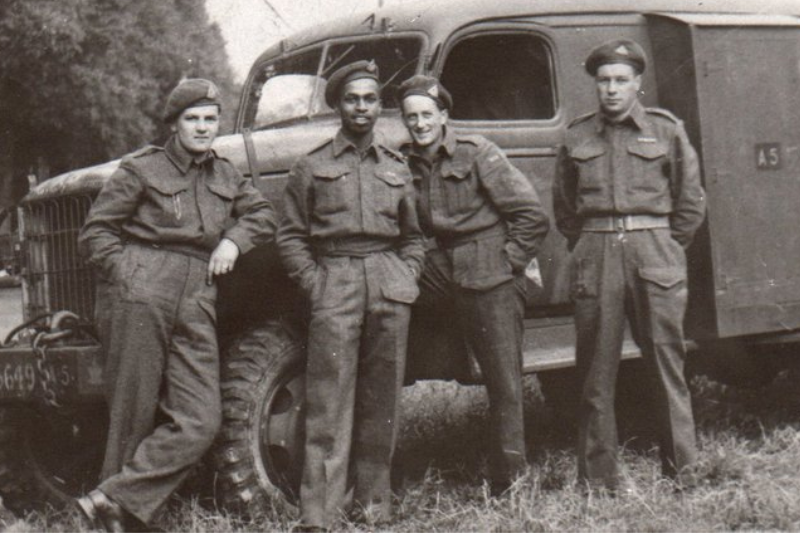
He turned 20 aboard the Queen Elizabeth in 1942, one of 23,000 young Canadians packed into a liner built for luxury. He came home four years later, having served with the Royal Canadian Corps of Signals in England, Italy and northwestern Europe. At the age he was sleeping in mud and sending coded messages from the mountains above the Mediterranean, I was choosing university electives.
He didn’t talk about it. My mother and my aunt heard almost nothing. It took a pestering grandchild on weekend visits to get anything out of him, and what came out was usually funny.
He told me about fishing in the Italian mountains with a Thompson submachine gun. “You didn’t have to hit them,” he’d say, eyes bright. “Just shoot near them and pick them up.”
He told me about his first Christmas overseas, outside Ortona, when some turkeys were “kind of confiscated” for the troops. It beat the usual dehydrated eggs, corned beef and the tinned Compo ration the men called “Muck-and-Vomit.”
And he told me about the helmet. He was shaving one morning near Ortona, with his helmet propped on a truck wheel. Someone brewing tea on a jerry-rigged stove set the camouflage netting on fire. The driver lurched the truck forward and flattened the helmet like a pancake. It was an odd size. Every replacement arrived after he’d been sent somewhere else, so he finished the war bareheaded.
The humour was a container. I learned that in the late 1990s, when I interviewed him for a newspaper profile and asked about his third day in Sicily. His convoy was attacked from the air. Of 60 men, five or six were killed and 15 to 20 wounded.
“They got the vehicle in front of mine and the one behind it,” he said. “I was just lucky.”
I asked if there were things he’d rather not share. He nodded and asked for the next question.
Later, when the First Canadian Division left Italy to prepare for D-Day, he stayed behind in farmhouses with a wireless set, sending fake signals so German intelligence would think the division was still there. Nobody got a medal for that. It worked anyway.
What he wrote down
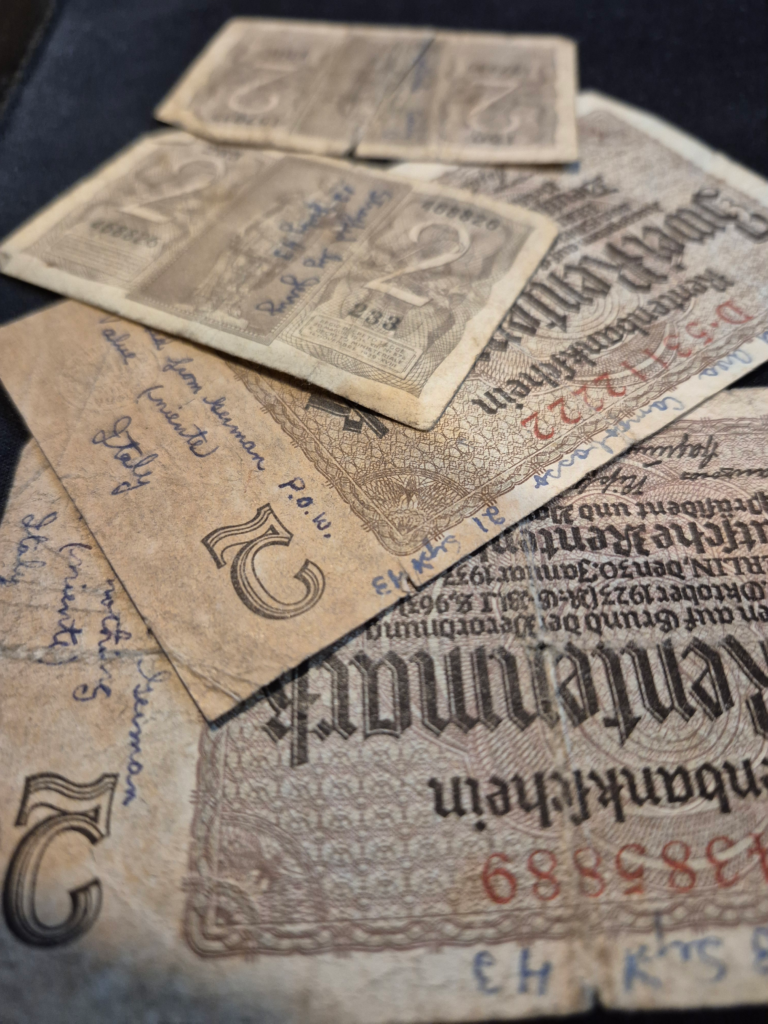
After he died, I found a box. Inside were Italian lire and German reichsmarks, worn soft as cloth, and he had written on them.
On a two-lire note: “Strafed by Jerry 12 July 43.”
On a reichsmark: “Received from German P.O.W. for nothing value. Italy 3 Sept 43.”
On another, a note about a “rest area” in Campobasso on Sept. 21, 1943.
With them was a pass dated March 21, 1945, authorizing Signalman J. Hart, B111985, to be in Rome “for purpose of duty and billets.” The army recorded that in triplicate, with a captain’s signature. The army did not record what it was like to be shot at from the air. He did that himself, on the nearest piece of paper, and then carried it for 63 years without showing it to anyone.
I’ve wondered whether his hand was shaking. I’ve wondered why money, and why he never mentioned it. The best answer I have is that he wanted proof. He was there, it happened, and he lived to write the date.
That’s the same instinct behind his greatest fear. A record only matters if someone reads it.
What the Dutch remembered
In 1995, he went back to Holland for the 50th anniversary of liberation. At Groesbeek Cemetery, where 2,338 Canadians are buried, there were poppies and flags on every grave. He said the Dutch kept those graves better than most people keep their own lawns.
“If it wasn’t for you people, I wouldn’t be here,” a Dutch woman told him. “I wouldn’t be around or my parents wouldn’t be around.”
The Dutch remember because they know what it is to lose a country and be handed it back. We have never had to learn it that way, and men like my grandfather are the reason.
He came home and got on with it. He was married to my grandmother, Bonnie, for 58 years. They raised two daughters, and he lived to see four grandchildren and two great-grandchildren. He put in 38 years at the same company and three as president of Royal Canadian Legion Branch 43 in Oshawa.
In my line of work, we talk a great deal about resilience, mental health and trauma-informed leadership. We should. But those conversations are a luxury his generation paid for. They came back from conditions that would break most modern workplaces in days and buried it in work, because there was no therapy on offer and nobody spoke the language of vulnerability.
The photograph in my desk
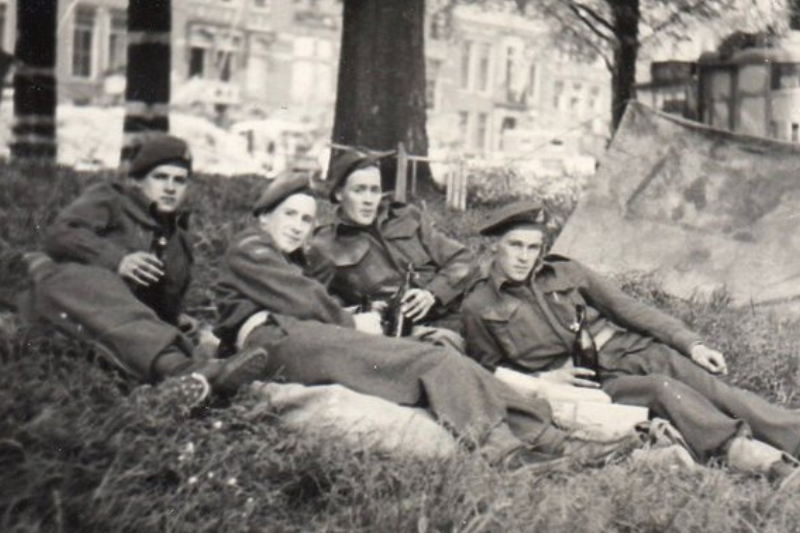
I keep a photo of him in my desk. It was taken somewhere in Holland in the spring of 1945. A group of young men in uniform, barely more than boys, are slouched on a hillside holding bottles of beer. The one on the far left looks, if you squint, a lot like me. He isn’t wearing a helmet.
I used to see the end of something in that picture. The war was nearly over and those boys were about to go home.
This year I see a request. He asked us to remember so that nobody would have to do it again. Remembering, in 2026, means saying four new names out loud: Wong, Farrell, Goulding, Lykkemark. It means knowing what this country cost, and saying plainly that it isn’t for sale.
After the strafing, my grandfather wrote one line on a two-lire note so there would be a record.
This is mine.