


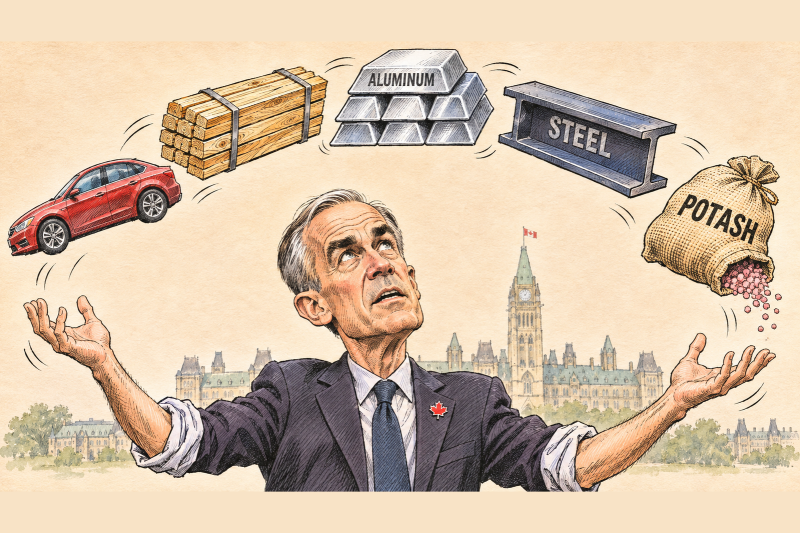
Prime Minister Mark Carney has produced the best line of the trade war. He delivered it over a video link from China, at the end of a nine-day trade mission.
He was speaking to the Dealbook summit about the state of talks with Washington. “We’d like to do a deal. If the U.S. doesn’t want to do a deal, we’re busy.”
Anyone who has ever sat across from an unreasonable customer, a stalling vendor or a counterparty who mistakes volume for leverage will want to borrow those last two words. I certainly do, and I expect plenty of competition.
The appeal is obvious. “We’re busy” is not a threat. It does not raise its voice, set a deadline or slam a folder shut. It notes that the other party is not the only item on the agenda and leaves them to do the arithmetic. It is the spoken version of glancing at your watch.
It’s a great line. But don’t skip the part that made it credible. After all, Carney did not say it from Ottawa on a slow afternoon. He said it at the end of a trip in which he brokered two free trade deals in a single day, with the Philippines and the 11-nation ASEAN bloc.
Together those make up a $6-trillion market. He said Canada is on the cusp of a deal with India within three months, and that talks with China had gone “exceptionally well.” By his count, Canada has free trade access to economies with some two billion people, and that number will soon reach three billion.
It is a list of alternatives, itemized and on the record. The line works because the evidence came first.
Compare it with the line it was answering. In October, U.S. President Donald Trump said the U.S. “holds all the cards” in its dealings with Canada. Carney’s reply this week: “Our cards are that everyone else in the world wants to deal with us.” Trump’s is a claim about leverage, and Carney’s is a claim about options. Leverage only has to be asserted, while options have to be shown. In a long negotiation, what you can show tends to outlast what you assert.
The same pattern turns up at bargaining tables, vendor reviews and retention conversations. The party with somewhere else to go rarely needs to say so. The party without one often says so at length, and loudly.
The rest of Carney’s remarks were less quotable but equally useful. The Democrats had just won both houses of Congress in a landslide, and he was asked whether that changed anything for Canada. “No, is the short answer.” The only thing that would improve relations, he said, is a reversal of the trade actions themselves. “What will change views is policy decisions that are taken and that will stick. It will take action as opposed to intent.”
Why does it work so well? Because it is the standard any wronged party applies to an apology. An employer that has cut staff, reorganized or broken a promise usually wants its people back on side quickly. A change of tone, a new leadership team or a warmer town hall all count as intent. Staff, like Canada, are waiting for the decision that sticks.
Carney also said that even with a deal, Canada does not want to slide back into ever-deeper integration with the U.S. He said Canada does not want to be “coerced” or “subjugated” by any major power again. That is the second half of “we’re busy.” Alternatives are more than a bargaining tactic. Once you have built them, you are less inclined to give them up, even when the original partner returns with better terms. Organizations that have depended on a single supplier, client or star performer will recognize the logic. Concentration looked efficient right up until it became a vulnerability.
None of this is free, and Carney did not pretend otherwise. He conceded the transition is not easy. The Section 232 tariffs on autos, steel, aluminum and softwood lumber have cost jobs and shuttered plants. A separate 50 per cent tariff hangs over a grab bag of other Canadian products. Conservative MP Adam Chambers, the party’s industry critic, warned against playing “chicken” with an administration that has “a lot of leverage and harm it may choose to impose on Canada.”
That is the strongest case against the posture. Being busy elsewhere does not cover this quarter’s layoffs, and new markets take years to matter as much as the old one did.
The alternatives have their own terms, too. In China, Carney won meaningful market access for Canadian commodities in exchange for letting a relatively small number of Chinese electric vehicles in at lower tariff rates. Being busy is not the same as getting something for free.
That is where most folks who steal Carney’s words will run into trouble. Said to a customer who accounts for most of your revenue, “we’re busy” is a bluff, and counterparties tend to recognize a bluff for what it is. The line only holds if the other work is real, signed and visible to the person you are saying it to.
Carney’s own target shows the scale involved: doubling non-U.S. trade within 10 years. It is a decade-long project to make a two-word sentence true.
Most people who say “we’re busy” are describing their schedule. Carney was describing work already under way, to the one party that most needed to believe it.
The line lands because it is not a threat. It is a progress report.